Power-Laws and Redistribution

In a recent issue of the New Yorker, Malcolm Gladwell revealed some surprising statistics about chronic homelessness and healthcare. The costs were more expensive than I could have imagined. But the problem was not nearly as widespread -- and that gave cause for optimism. In an interview with an administrator in Nevada, Gladwell wrote:
"We came up with three names that were some of our chronic inebriates in the downtown area, that got arrested the most often," O’Bryan said. "We tracked those three individuals through just one of our two hospitals. One of the guys had been in jail previously, so he’d only been on the streets for six months. In those six months, he had accumulated a bill of a hundred thousand dollars—and that’s at the smaller of the two hospitals near downtown Reno. It’s pretty reasonable to assume that the other hospital had an even larger bill. Another individual came from Portland and had been in Reno for three months. In those three months, he had accumulated a bill for sixty-five thousand dollars. The third individual actually had some periods of being sober, and had accumulated a bill of fifty thousand."

Gladwell interviewed Dr. Culhane, who had written his graduate dissertation on homelessness and had slept in shelters, for research:
Homelessness doesn’t have a normal distribution, it turned out. It has a power-law distribution. "We found that eighty per cent of the homeless were in and out really quickly," he said. "In Philadelphia, the most common length of time that someone is homeless is one day. And the second most common length is two days. And they never come back. Anyone who ever has to stay in a shelter involuntarily knows that all you think about is how to make sure you never come back."

The next ten per cent were what Culhane calls episodic users. They would come for three weeks at a time, and return periodically, particularly in the winter. They were quite young, and they were often heavy drug users. It was the last ten per cent—the group at the farthest edge of the curve—that interested Culhane the most. They were the chronically homeless, who lived in the shelters, sometimes for years at a time. They were older. Many were mentally ill or physically disabled, and when we think about homelessness as a social problem—the people sleeping on the sidewalk, aggressively panhandling, lying drunk in doorways, huddled on subway grates and under bridges—it’s this group that we have in mind.

Culhane’s database suggested that New York City had a quarter of a million people who were homeless at some point in the previous half decade —which was a surprisingly high number. But only about twenty-five hundred were chronically homeless.

It turns out, furthermore, that this group costs the health-care and social-services systems far more than anyone had ever anticipated.

The guy I saw on the sidewalk, that summer evening? He may well be one of the city's 2500. But New York's Bravest said they didn't recognize him as a regular, when they took him down the street to the hospital. Either way, as a first timer to the hospital, he would have had forms generated, labs drawn. Depending on the attending, maybe even a head CT. If his belly was tender on physical exam, maybe much more. It's easy to see how an indigent substance abuser can rack up millions of dollars of healthcare charges over the year. Faced with this tremendous expense from a relative small group, Gladwell found people proposing a revolutionary solution:
"I spoke with people doing services there. They had a very difficult group of people they couldn’t reach no matter what they offered. So I said, Take some of your money and rent some apartments and go out to those people, and literally go out there with the key and say to them, 'This is the key to an apartment. If you come with me right now I am going to give it to you, and you are going to have that apartment.' And so they did. And one by one those people were coming in. Our intent is to take homeless policy from the old idea of funding programs that serve homeless people endlessly and invest in results that actually end homelessness."

There's an obvious challenge to such generosity:
Post had just been on a conference call with some people in New York City who run a similar program, and they talked about whether giving clients so many chances simply encourages them to behave irresponsibly. For some people, it probably does. But what was the alternative? If this young man was put back on the streets, he would cost the system even more money. The current philosophy of welfare holds that government assistance should be temporary and conditional, to avoid creating dependency. But someone who blows .49 on a Breathalyzer and has cirrhosis of the liver at the age of twenty-seven doesn’t respond to incentives and sanctions in the usual way.

Power-law solutions have little appeal to the right, because they involve special treatment for people who do not deserve special treatment; and they have little appeal to the left, because their emphasis on efficiency over fairness suggests the cold number-crunching of Chicago-school cost-benefit analysis. Even the promise of millions of dollars in savings or cleaner air or better police departments cannot entirely compensate for such discomfort.

Yet, despite their lack of appeal to both ends of the political spectrum, these programs may just work.

Gladwell's piece ends on a sour note -- one of the more lovable alcoholics, who had been a regular to many healthcare workers, dies. When his caregivers grieved, it reminded me that homelessness isn't just a problem that needs a solution, a cost that needs to be controlled.

And it provided me with the proper perspective to answer a friend, who recently asked me, "Now that you're well into your internship, and have seen countless drunks and alcoholics -- many repeatedly -- would you call 911 again?"
Love and Support

In a curious convergence of two of my favorite writers, Malcolm Gladwell was interviewed by Bill Simmons, the former Boston Sports Guy and now ESPN.com columnist. Gladwell talked about the intersection of writing and sports, and the common drive for excellence:
I'm happy writing anywhere and under any circumstances and in fact I'm now to the point where I'm suspicious of people who don't love what they do in the same way. I was watching golf, before Christmas, and the announcer said of Phil Mickelson that the tournament was the first time he'd picked up a golf club in five weeks. Assuming that's true, isn't that profoundly weird? How can you be one of the top two or three golfers of your generation and go five weeks without doing the thing you love? Did Mickelson also not have sex with his wife for five weeks? Did he give up chocolate for five weeks? Is this some weird golfer's version of Lent that I'm unaware of?

And, from a conversation on individual athletes on supportive teams, Gladwell was able to generalize about his own situation at the New Yorker and the theme that runs through much of his work:
My point is its almost impossible to know where the person ends and their environment begins, and the longer someone is in a particular environment the blurrier that line gets. More specifically, you can't make definitive judgments about the personal characteristics of people who come from structured environments. What does it mean to say that a Marine is brave? It might mean that a Marine is an inherently brave person. It may also be that the culture of the Marine Corps is so powerful, and the training so intensive, and the supporting pressure of other Marines so empowering, that even a coward would behave bravely in that context. That's what I mean when I say I'm Plummer: I'm working in a such a supportive and structured environment that I no longer know where my own abilities end and where the beneficial effects of the environment begin. Just think if you were a New Yorker writer, Bill. Suddenly your editors would be asking you to make your stories longer. You spend the summers at a writer's colony in New England, working on an historical novel based loosely on Freud's famous falling-out with Adler. And girls would hit on you in bars because they would think of you as cute in that nerdy, bookish way. But you'd still be Simmons, wouldn't you?

Just a funny, interesting interview. It makes me thankful for my supportive environment(s) and hopeful that these two collaborate again (but if they should have a famous falling-out, Deadspin has predicted a winner).

I've also learned that Malcolm Gladwell now has a blog. If he keeps in up, and spends a little more time writing about healthcare, I may just have to ask him to host Grand Rounds.

Little Things

Nurses are on the mind these days -- for the first time in its 18 months, Grand Rounds has nurses as back-to-back hosts. Last week was Emergiblog, this week is GeekNurse.

It's got me thinking -- I'm pretty lucky to be working in hospitals offering some of the city's best nursing. Not being required to start my own IVs, or print labels, or push many meds, really frees up my time to see more patients, which is really what I ought to be doing.

I've written before about reporting respiratory rates -- how nurses (and EMS, I gather) often just report "20 breaths per minute" when a patient appears to be breathing comfortably.

There are a few cases where that's dangerous -- such as, for instance, when the respiratory rate is actually 20.

I've noticed that our ED's nurses, when they want to bring to my attention a patient's tachypnea, actually record "19" or "21" as the respiratory rate ... It's like they're sending me a secret code through the vitals that not all is well. Sometimes, when things are busy, this can be our only interaction -- so it's particularly sly and efficient.

Dry Wit Large


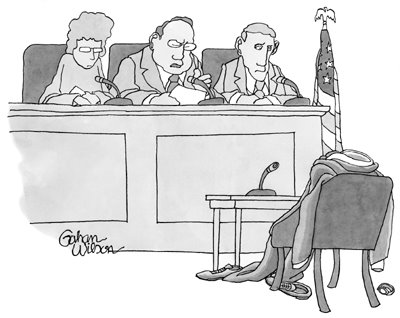
In the back page of The New Yorker, they now offer up cartoons for readers to caption. Not only have I worked with this week's caption contest winner, I've written about him before (during my residency interview, he coined the phrase 'cocktail party research' which I still use frequently... at cocktail parties).

He said his past research was guided so minimal efforts yielded maximum exposure.

With this caption I'd say that he's continued to follow that dictum -- but I've also learned he's written a fiction book about malpractice, surely a lot of effort for a smaller audience than the New Yorker. The book is narrated from the perspective of the defendant, one Dr. Charles (but not that one)...

If the book is as funny as his caption, I'll happily count myself as a member of this smaller audience.

Timeless

By 4:15 AM, the bakers at Hot & Crusty are putting their fresh-baked muffins and croissants on the shelves. If I'm awake and at all hungry, I make a point of stopping by and picking something up.

Which I just did (they're delicious). I thanked the man behind the counter and wished him a good night.

"Good night? It's a brand new day, boss!"

And so it is. I used to be one of those annoying kids in school -- so enamored with the idea of being up past midnight -- that I'd interject every chance I could something like, "technically, it's already tomorrow."

But after these last few rotations through emergency, night and day have lost their special distinctiveness. It doesn't faze me anymore when patients present at wee hours, asking for a "checkup" or inquiring about their monthlong knee pain.

In the city that never sleeps, every moment marks a brand new day, for someone.

Front Row

In one of the emergency departments I work in, the clerk's desk is located near the exit and, shall we say, safely the front-lines of patient care. I sometimes remark to the clerks when they missed a really good case or interesting trauma, but they seem to be happy with their location.

Late one night, I was finishing some charting near the clerk's desk when a family of three came up to say goodbye. Their son had been in a car accident, in which he had lost consciousness. After a negative head CT, a benign exam and some pain medication, he was feeling fine and good to go.

As I wished them a farewell, I remembered an abrasion on the young man's left hand.

"Wait -- I've got just the thing for that," I said, reaching for my bacitracin, gauze and tape (the interns have well-stocked cargo pants).

I put the patient's hand on the clerk's desk and squirted some bacitracin onto the gauze. "Now you're finally getting a front-row seat" I told the clerk.

As I applied the dressing, the patient wobbled a little, and I noticed he seemed a little pale. "Everything ok?"

"uh......."

"Hey, ah, are you alright?"

The patient was staring off beyond my shoulder, with wide, wide pupils. He replied, in a monotone: "I can't see."

He stumbled a little bit and I caught him. "Why don't we get you back to your stretcher," I offered, with a cheeriness that rang utterly false. My mind was racing -- I haven't seen a fainting spell like this, could we have missed an epidural?

At that point, the father slumped to the floor. "My son... My son is blind."

Oh my God, they're dropping like flies.

My attending rushed over to catch him. The man was cold and clammy, similarly pale.

"No, sir, he's ok!" I was insistent. "We scanned his head. He's just... doing what you're doing."

We got the father-and-son team back to the stretchers, had them lie down for a bit, and gave them something to drink. They perked up in short order -- no hematomas, just... relational syncope.

When they felt ready to try again, I walked the family to the door, passing the clerk's desk. She (quietly) warned, "Dr. Genes, I've seen enough tonight."

As we passed through the waiting room, a question occurred to me: "Hey, who's driving?"

The father shot a glance at his son, who was shaking his head slowly. The mom chuckled to herself, as the family made their way out of the hospital.

Respirar Profundo

Songs with the word "breathe" in the title that I have enjoyed, listed in order of when I first heard them:
Pink Floyd: Breathe in the Air
Prodigy: Breathe
Telepopmusik: Just Breathe
Sixpence None the Richer: Breathe Your Name (hey, cut me some slack, I'm omitting the entries from Maroon 5 and Faith Hill)
Science Dept (featuring Erire): Breathe
Sia: Breathe Me

The newest addition to the list is Anna Nalick's Breathe (2 AM), which played during the climax of Grey's Anatomy tonight. The lyrics should appeal to bloggers, or at least, MySpace users.

Prototypical

I found myself blathering at Medgadget the other day about the inefficiencies of chest pain admissions. It made me nostalgic for my first patient I saw as a newly-minted physician, one Saturday morning back in July.

After days of orientation, and then a half-hour shadowing a senior in the Emergency Room, learning about the translator phone, computerized order-entry, and the nurse's names, I was eager to begin.

There was one chart in the to-be-seen rack. I picked it up. The triage note declared CHEST PAIN as the chief complaint.

I put the chart back down. "Probably not a good teaching case," I thought, recalling my medical school ER rotations. "And the attending will want to make the decision to rule him out for MI, herself."

I was ready to wait for another chart when it struck me: I'm not a student anymore. And today was a good day to get re-acquainted with a symptom I'll be encountering daily, for the rest of my career.

And so, I saw my first patient. He was in his early 50's, was mildly hypertensive on no meds, quit smoking, with no other risk factors. He reported a vague pressure pain around his sternum for the past few days, on and off, unrelated to exertion or meals. Pretty normal EKG, with no older ones on file.

I poked, I prodded, I tried to get his story and exam to lean one way or another. But his diagnosis remained ambivalent.

So, with a deep breath to acknowledge this momentous occasion, I wrote my first order as a physician:
Aspirin 325 mg PO x1.

The rest of the cardiac workup followed. It seemed a little dramatic to me, ordering all this bloodwork and monitoring for what would likely be reflux or costochondritis.

I was knee-deep in other patients, an hour or so later, when the attending pulled me aside.
"That first patient you saw, the rule-out MI?"

"Yeah?"

"He's ruling in."

"Really?"

She smiled. "Good pickup. I guess this bodes well for your career."

As I recall, the patient got cathed and did okay. And I haven't had much hesitation to rule out MI in the many, many ambiguous chest pain cases I've seen since.

Blanketed

Yesterday, more snow fell in New York City than at any other time since record-keeping began. And I was working in the ER during the storm's peak hours.

Patient volume was down for a Sunday, but only a little. And, while we had some shoveling-induced chest pain toward the end of the day, the majority of patients I saw had the same routine complaints as any other day: Headache for a month, cough and sore throat for a week, and so on. Pretty remarkable, really. The only difference in my practice was my standard opener, which changed from:
What brings you in today?

to
What, in the name of all that is good and decent, brings you in today?

New Yorkers are clearly resilient to external influences, but perhaps not as tough when their troubles arise from within.

Acting Out

I've always considered rounding on the hospital floors to be one of the most unnatural of human interactions. The emergency medicine version -- signout -- is a far more efficient and humane process, where the new doctors coming on shift meet the patients, get a blurb about their history and workup, and learn what's pending before discharge or admission.

But, just like rounds can be a source of occasional amusement, so too can signout. The other day, a colleague was signing out a patient as follows:

"This 31 year old man was ped-struck at last night. Positive LOC according to EMS, EtOH on board, good vitals, A and O times three since arrival here. His head CT and C-Spine were negative."

"How about pain? wounds?" the receiving resident asked.

"Pain's under control, no lacs. He's got abrasions on his right ear and temple." Then she tapped her temple, for emphasis. Her expression was one of concentration -- she was recalling the man's initial presentation in the trauma room.

"His right elbow, too." As was said this, she clasped her right elbow. I looked over at my senior, who was starting to smile.

"Also a big abrasion across his abdomen," she continued, as she rubbed her belly. "And bilateral knees" -- at which point she bent down and grapsed her knees.

When the resident straightened herself up, she saw our team stiffling the giggles.

"Hey!" she offered, in good-natured protest. "It helps me remember..."

The attending started singing, Head, Shoulders, Knees and Toes, and we merrily made our way to the next patient...

Unexpected Report

Recently, there's been a lot of traffic in the Emergency Department, and a lot of traffic in social departments, as well. So many new faces and challenging interactions -- much of it is very gratifying, but some of it stings and prompts second-guessing.

All that, combined with a bone-deep fatigue, unseasonable weather, and looming deadlines has led to a kind of constant, low-level paranoia I'm not accustomed to.

Maybe this is part of developing into a vigilant attending, or being a considerate person. Maybe I should lay off the coffee and get some sleep.

Either way, Haloscan informed me, just now, that a comment was made to this post from 2004. A few weeks ago I'd brush it off as a tasteless hoax or misguided plea. But considering my mindset these days, coming at the end of a long night (not to mention the subject matter), I must say: I'm a little creeped out.

(The comment counter says 0 for older posts, but trust me, there are comments. And the commenter's handle suggests he's got a sick sense of humor, or was actually there).

Overheard in a New York Comedy Club

The scene: a faded, half-filled comedy club, still clinging to its Seinfeld-era glory. A spotlight shines on a brick wall, a black painted wooden floor, and a lone microphone. A pathetic MC is trying to work the crowd.

MC: And how about these home defibrillators, huh?

The Crowd does not respond.

MC: I mean, do you really want Grandma shocking Grandpa? She can't even program a VCR!

Someone in the crowd chuckles softly, for a few seconds. Then, silence. A doctor, sitting amongst his fellow interns, raises his hand. The MC seizes upon the opportunity.

MC: You, sir?

Doctor: Yeah, so, those defibrillators detect whether it's okay to shock or not. The only thing people have to do is put the paddles on the chest and listen for instructions.

MC pauses for a moment, stunned. Thanks for interrupting my set!

Doctor: Just trying to help.


The MC introduces the next comic, and another teaching moment comes to a close.

Convergence

I have observed a striking correlation between blogging, interest in emergency medicine, and geocaching. First in myself, then Doc Shazam, and now Jaime Marks from the Differential went on a GPS hunt with her EM attending and a nurse.

OK, my n is 3. Still, it seems like these are naturally overlapping interests, and I can't offer an explanation why. It's worth noting, however, that none of these activities were possible until very recently.

Lightning in a Bottle

There is no better way to start your workweek than listening to "Bottle Rocket" by The Go! Team. It starts abruptly with a bright, heralding trumpets, crisp drums, a bouncy keyboard, and a fast-paced, almost indecipherable rap.

The first ninety seconds leave you breathless. Then, just when you think the song will start to get repetitive, the trumpets blare and give way to a most unexpected harmonica solo.

"This harmonica solo will not be topped," I thought, on first listen.

But then the cheerleaders started chanting, and I knew I was wrong.

I smiled all the way to work.

Reflecting Absence

Lately I've had the opportunity to spend some time in in northern New Jersey. Oddly enough, it's here where I've encountered the most raw emotion about 9-11. Maybe because it's the way the Manhattan skyline dominates the view here -- despite its own new construction, Jersey City and Hoboken are very much in New York's shadow. Or maybe it's because I'm working with EMT's, who have more than their share of stories from that terrible day.

Within a few minutes responding to a call near Liberty Park, or driving along the banks of the Hudson River, the tales come rushing forth: The paramedics they knew that died that day, the mutilated patients coming across the river on the ferry, the explosion in the WTC PATH station that nearly suffocated rescue workers across the tunnel.

While they're recounting these stories, their eyes invariably settle on a point above the southwest corner of lower Manhattan, where the twin towers once stood.
"As beautiful as the city looks tonight," one paramedic explains, "those towers, you have no idea how tall they were... They were bigger than everything."

In the late sixties and early seventies, Manhattan added 8-12 million cubic feet of office space to its skyline -- the equivalent of downtown Pittsburgh -- every year. Then, in 1973, the World Trade Center was dedicated, itself sporting over 13 million square feet.

So colossal, so incongruous with the genteel buildings around them, one could understand how some disapproved of the massive structures. Columnist George F. Will, calling the twin towers both hopeless and pointless, shared his objection to their aesthetic, in 1977:
"I have a recurring nightmare - if that is the word - in which two Concorde super-sonic airliners, one British and one French, slice the towers in half, a collision of modern achievements."

But the brash bulk of the buildings could also inspire. The WTC was a source of breathtaking photos and copycat architecture. A band even named itself "I am the World Trade Center" (their first album was released in July of 2001. Track 11 is called "September").

Stark, minimalist, utterly dwarfing everything around it, the twin towers were hard to get used to. But their absence is even harder to accept.

You can sense the loss when you look at the World Financial Center complex. The twin towers were originally at the edge of the island, but the dirt from the WTC excavation gave rise, in the mid-80's, to the World Financial Center buildings. Now those four buildings look like orphans, and in a sense, they are.

No view is as powerful to me, however, as the experience passing through the temporary WTC transit hub.

Making my way from the MTA to the PATH trains, along the vast concrete floor, I can see through the open air to Ground Zero to my left. The rebuilt WTC 7 is also visible to the west, and from this vantage point below, the protective metal plating along the base catches the sun, and doesn't look quite so repellent.

The bare station -- which will someday be home to one of Calatrava's sweeping white roofs -- is now decorated only with oversized arial photos of lower Manhattan, and large white banners featuring quotations about the city.

At first I thought the effect was Orwellian. But after a few trips among the energy and purpose of the commuters, the juxtaposition of the cheery signage with the bleak emptiness of Ground Zero, gives me a feeling of optimism I wouldn't have believed I could associate with this site.

My favorite banner bears an old quotation from journalist and author John Gunther. The banner ends before the third comma, but I find the complete quote to be entirely appropriate:
New York City, the incomparable, the brilliant star city of cities, the forty-ninth state, a law unto itself, the Cyclopean Paradox, the inferno with no-out-of bounds, the supreme expression of both the miseries and the splendors of contemporary civilization, the Macedonia of the United States. It meets the most severe test that may be applied to the definition of a metropolis: it stays up all night. But also it becomes a small town when it rains.

'Because the world is backward'

There's a masterful piece in today's New York Times about the Mini-Mental Status exam. Adapted from Bernard Cooper's book, it's the story of a doctor administering a battery of questions to an aging man, while his son looks on:
First she asked my father to tell her the date. I silently answered along. He got it right. I was off by a couple of days. I scooted my chair closer. Now I had something to prove. I felt as if my father and I were opponents on a quiz show.

"What state are we in?" "City?" "Hospital?" "Floor?"

Not until she whispered "Bernard" did I realize that I'd been muttering answers under my breath. But I was sure my father hadn't heard me. And anyway, I got them right. Dad, on the other hand, didn't know what floor we were on. But he probably would have known it was the third if he had been the one to push the elevator button instead of me. The mechanics of recall are delicate, so iffy and contingent.

My father lowered his head and laced his fingers together in his lap. He had the shamed, inward look of a man who knows he has blundered but doesn't know how.

"Mr. Cooper?" she asked. "Are you ready to continue?"

My father nodded. His head seemed heavy, as if with answers that would soon elude him.

"Spell 'world' backward," the doctor said.

"Why 'world'?" Dad asked, peering over his glasses.

Because the world is backward, I said to myself. Laws are repealed. Iron rusts. Logic unravels.

The trio continues processing the questions, only to get hung up by on a pen. Cooper captures the horror of forgetfulness, the absurdity of this test, and also its strange appeal.

These days I'm riding along with EMT's in ambulances. The crews are very efficient and well trained, and I've learned a lot about their jobs. To return the favor, I try to help out around the truck, or expand upon part of a patient's workup -- EKG interpretation, the differential for syncope, etc.

Just recently we were called for an assault on a young man, it turns out he was hit over the head by "some dude", at the bus station. He couldn't recall much about it, and had had a few drinks -- but there was something odd about his affect, on top of it. Aside from a small head laceration, his physical exam was unremarkable. But when the cops disclosed to us that the patient didn't know where he was, I launched into the Folstein (another name for the above-mentioned mini mental status exam).

The EMT's, and even the patient, were thrilled with the questions:
"Holy crap, doc!" one paramedic exclaimed. "I had the wrong date today."

"So I can say 'No ifs, ands, or buts', huh? Is grammar really that important?"

I sensed the test was not fulfilling its diagnostic usefulness. So I ditched the rest of the Folstein exam, and, egged on by my audience, went for broke:
"Okay, one last question. You know the expression, 'people in glass houses shouldn't throw stones' -- what does that mean to you?"

The group was stunned. Here was something not pondered in many bus stations. After a moment, the patient abstracted the meaning of the maxim.

The excitement faded, and the crew returned to their paperwork. Perhaps they had a new appreciation of how brain function can be assessed with a few simple questions. At the very least, they'd found a new diversion to challenge each other, and the patients they'd encounter that night.

A Bleat from The Bleat

Even Lileks gets the blues:
Well, I went off on a rant tonight; didn’t mean to, but it’s been building. I blame myself; I am feeling particularly small and useless these days. For God’s sake, my primary contribution to the world today was a 300-word piece on pretentious bath towels. Seventeen more years of this, then the gold watch? How exactly is it possible that I love my job, love my life, feel extraordinarily lucky and grateful, and still want to bang my head into the kitchen counter at night.

If you'd told me, a year ago, the size of our audience on Medgadget or Pre-Rounds, I wouldn't believe you. But sometimes, late at night, by the kitchen counter, it all seems like pretentious bath towels. Thank goodness for the privilege of my day job, for times like those and really for all times.