The bird on the fire escape has been with me for over a week. She's chosen some of my scraggly philodendron vines as the basis of her nest, and is guarding her eggs (the second egg appeared on Orthodox Easter Sunday).
Sometimes I give her some privacy by lowering the blinds -- I suppose my proximity to her nest gives could give her some anxiety (she's three feet away as I write this). But I like to think she's getting used to me, and my offerings of Wheat Thins.
On both Monday and Tuesday afternoons this week, around 5:30 or so, I was present to observe a similarly-marked brown bird land on the fire escape. They both gazed warily at me for a few moments -- then the nesting bird promptly stood up and took flight. Here to stay as the replacement, the new bird hopped into position over the eggs, in the nest. I can't really tell which bird is the father, or even if such gender roles apply to birds in Manhattan, but I very much enjoy this family growing outside my window...
The routine of floor medicine continues, with its steady supply of triumph and tragedy, teaching and tedium. It's springtime for the interns, who have more or less gotten the hang of it, and made peace with their roles and abilities. In a few hours I'll go to work, then from the hospital I'm off to my best friend's wedding. I'll be back at the hospital in time for call on Sunday, to return to this roost Monday morning and file a column.
These are that days, and the stage in life, that my friend and I have wondered about for about fifteen years. We couldn't have predicted all the specifics; no one could have. But this work, this place, these people in my life -- it's everything I had hoped.

In Voro, Veritas
This month's Atlantic has the best writing I've seen on competitive eating (and naturally, that includes my musings on the topic). In the past I've called for scientific investigation into this subject, but in the meantime I'll settle for amazing anecdotes and in-depth reporting:
Sonya Thomas is known as the Black Widow. She's not the only personality on the eating circuit, though. Besides Kobayashi and her, the organizer of the major competitions, George Shea, also seems like a character for the ages. He narrates the events like some kind of postmodern auctioneer. The effect inspired the Atlantic's writer, Jason Fagone, to some lofty prose:
Some statistics, for future reference to just how disgusting the sport is (going back to the original meaning of disgusting):
More analysis from elsewhere on the web:
I've never bought that explanation; I think instead they've got some kind of smooth muscle constriction defect or loose pyloric sphincter. But the closest thing I can find to a scholarly approach to competitive eating is this master's thesis -- sadly, it's for a degree in fine arts -- the document is a story.
Brian "Yellowcake" Subich, a top-twenty eater, tells a story about a baked-bean contest from the summer of 2004. The field included Sonya, Subich, and Cookie Jarvis. After just two and a half minutes, George Shea announced that Sonya was almost done with her 8.4 pounds of beans. "I said, 'You have to be freaking kidding me,'" Subich told me. "What does she do? Pour ’em down her shirt? Put 'em into a plastic bag?" At Shea’s announcement, Jarvis lifted his head, glanced at Sonya, registered what Subich calls "the most crestfallen look you could ever imagine," and vomited beans through his nostrils.
Sonya was forcing a realignment in American eating. When asked for the secret to her success, she would just wink and describe her love for her adoptive country, as if that explained everything.
"In America," she told me, "if you have desire you can do anything. Is big. Big." She holds her hands out wide. "Big country!"
Sonya Thomas is known as the Black Widow. She's not the only personality on the eating circuit, though. Besides Kobayashi and her, the organizer of the major competitions, George Shea, also seems like a character for the ages. He narrates the events like some kind of postmodern auctioneer. The effect inspired the Atlantic's writer, Jason Fagone, to some lofty prose:
Shea’s eating contests are poetic in their blatancy, their brazen mixture of every American trait that seems to terrify the rest of the planet: our hunger for natural resources that may melt the ice caps and flood Europe, our hunger for cheap thrills that turns Muslim swing voters into car bombers. If anti-American zealots anywhere in the world wanted to perform a minstrel show of our culture, this is what they’d come up with. Competitive eating is a symbolic hair ball coughed up by the American id. It is meaningful like a tumor is meaningful. It seems to have a purpose, a message, and its message is this: Look upon our gurgitators, ye Mighty, and despair. Behold these new super-gluttons, these ambassadors of the American appetite, these Horsemen of the Esophagus.
...Here on the gluttony circuit, atop the same cultural terrain that made me feel, in my bitterest moments, ashamed to be an American, the eaters were planting their dearest desires—for fair and honest competition, for a pat on the back, for a chance to get noticed, to prove themselves, to make their kids and spouses proud.
Some statistics, for future reference to just how disgusting the sport is (going back to the original meaning of disgusting):
The key benchmark of greatness in competitive eating, akin to rolling a 300 game in bowling or scoring under par in golf, is to eat twenty Nathan’s hot dogs in twelve minutes. This is called "doing the deuce." By the time an eater has done the deuce, he or she has consumed 4.4 pounds of solid food and a few pounds of water, has taken in 6,180 calories, 403 grams of fat, and almost 14 grams of sodium, and is ready to lie down someplace air-conditioned, close to a toilet.
More analysis from elsewhere on the web:
It is possible to train ahead of time for an eating contest, although the IFOCE does not recommend it. Competitors can train their brains to ignore the "full" feeling (actually the stomach muscles relaxing as they stretch) by repeatedly filling the stomach with large meals or through water training. Water training requires drinking an entire gallon of water in 30 seconds. The water stretches out the stomach. Supposedly, this makes it easier to down food in huge quantities. Neither of these activities is healthy. The water exercise can be very dangerous, resulting in perforations of the stomach lining and water intoxication, which is potentially fatal...
When small eaters like Thomas and Kobayashi first arrived, some eaters developed the theory that fat actually hinders competitive eating. The idea was that a lot of fat around the mid-section made it too difficult for the stomach to expand. This theory was originally proposed by eater Ed Krachie. His paper on the subject, "Can Abdominal Fat Act as a Restrictive Agent on Stomach Expansion? An Exploration of the Impact of Adipose Tissue on Competitive Eating," was rejected by numerous scholarly journals, including the New England Journal of Medicine. However, a 2003 Popular Science article supports the theory: "The size of the stomach at rest is inconsequential. All that matters is the stomach's ability to expand, to adapt itself to the amount of food being shoved down the esophagus. A skinny man's stomach has little fat to push against it and fight the food for space" [ref]. Some eaters believe that a muscular abdomen hinders stomach expansion as well, although Kobayashi's muscular body would seem to contradict this theory.
I've never bought that explanation; I think instead they've got some kind of smooth muscle constriction defect or loose pyloric sphincter. But the closest thing I can find to a scholarly approach to competitive eating is this master's thesis -- sadly, it's for a degree in fine arts -- the document is a story.
One last admission
There's so many things to do overnight on medicine call. I've got to see the new admissions, write up the H+P's, order labs and tomorrow's procedures, handle dozens of cross-coverage checks and answer random calls from the floors.
So, when it's all over and I come home, the list-making tends to continue. Today was no different -- I sat at my computer by the window, overlooking the glorious spring day unfolding just beyond my fire escape, and began composing the list of post-nap tasks and activities.
Some movement caught the corner of my eye. There, on the fire escape, a bird had nestled in amongst the tangled philodendron vines. She adjusted her position, I guess, to better assess the threat.
We stared at each other a few moments. Most birds don't linger on my fire escape for too long, but she seemed pretty invested in the place. Was she sick? Injured? Or just resting?
"I've had that plant for a while, do you like it?" I asked. She winked at me.
"OK. Maybe you had a rough night, too. Tell you what: If you're still here when I wake up, we'll call a consult and consider some imaging. OK?"
She consented, and I had a new item for the top of my list.
The Status of Bloggers
Envision Solutions, a marketing firm, has put together a 110-page guide to healthcare blogging. It's available for $36.95, but will become more expensive after May 30th (which is curious, because it ought to be obsolete right around then). Amy from DiabetesMine alerted me to the publication, and from the table of contents, I can see they've excerpted her. It seems like "Healthcare Provider Blogs" got about 6 pages... which is nice.
Hopefully they mentioned medical student Graham Walker -- but if not, he may get some consolation from the fact he appears in the new graduate rankings issue of US News and World Report, in their article on academic blogging/
Daniel Drezner is also interviewed:
Of course, the peer-review that leads to general popularity in the acamdemic blogosphere is at least comparable to what goes on in a manuscript review. Drezner otherwise hits the nail on the head.
Another way of putting it: Atul Gawande has about 25 citations in pubmed, many of these are articles in JAMA and the NEJM -- but very little of it is actual new research. Mostly it's his interviews, summaries and opinions (we're not even counting his New Yorker pieces). His stuff is extremely well written and enlightening, but I've noted before there's some resentment towards his position and frequent pontifications. I wonder: will he be penalized compared to an age-matched peer with 25 publications, when it comes to tenure review?
Similarly, I'd be curious to see how Graham and others handle questions about blogging during residency interviews (the new season is just six months away). My freelance writing and blogging didn't come up much on the interview trail, but when it did (and since) the reactions have been fortunately positive. So far.
Hopefully they mentioned medical student Graham Walker -- but if not, he may get some consolation from the fact he appears in the new graduate rankings issue of US News and World Report, in their article on academic blogging/
Daniel Drezner is also interviewed:
Those already working in academe may also find themselves in hot water. Political science Prof. Daniel Drezner, for one, believes that his own well-known blog, www.danieldrezner.com, may have played a role in his being denied tenure at the University of Chicago last year; he now cautions graduate students and untenured peers to think carefully before creating web diaries themselves. The ivory tower's old guard, he argues, is likely to overestimate the amount of time it takes to maintain a blog and also fail to acknowledge any potential intellectual value, among other downsides. "One of the problems with blogging is that it provides an alternative route through which academics can attain status, outside the more proper, traditional, peer-reviewed path," adds Drezner, who'll move to a tenured post at the Fletcher School of Law and Diplomacy at Tufts University this summer. "As a result, there's always going to be hostility toward people who manage to do that, in the same way there is toward those who write only popular books."
Of course, the peer-review that leads to general popularity in the acamdemic blogosphere is at least comparable to what goes on in a manuscript review. Drezner otherwise hits the nail on the head.
Another way of putting it: Atul Gawande has about 25 citations in pubmed, many of these are articles in JAMA and the NEJM -- but very little of it is actual new research. Mostly it's his interviews, summaries and opinions (we're not even counting his New Yorker pieces). His stuff is extremely well written and enlightening, but I've noted before there's some resentment towards his position and frequent pontifications. I wonder: will he be penalized compared to an age-matched peer with 25 publications, when it comes to tenure review?
Similarly, I'd be curious to see how Graham and others handle questions about blogging during residency interviews (the new season is just six months away). My freelance writing and blogging didn't come up much on the interview trail, but when it did (and since) the reactions have been fortunately positive. So far.
ED Visits from Homeless Alcoholics, Revisited
This month's Annals of Emergency Medicine has a report from the Serial Inebriate Program in San Diego (it sounds like a dispatch from Spring Break, but in fact is an attempt to stop the revolving-door of drunks in the ER).
I blogged about Malcolm Gladwell's coverage of programs like this, just recently. To borrow from his latest column, he provided "story" reasoning, whereas this Annals article provides a "technical account" explanation.
The long and short of it, from the intro and discussion:
Many more nuggets in the article, with citations to many more articles on homelessness and ED frequent fliers (yet another medicine / airline analogy). And, of course, profound limitations that leave many questions of costs and long-term effectiveness unanswered (EM research, sigh).
Moreover, San Diego's program is not as revolutionary as Nevada's or Denver's, in that it relies on courts and legal threats more than largesse and social work. The authors expressed surprise that they were able to persuade even 156 of San Diego's chronic alcoholics to sign onto 6 months of treatment (even with the threat of jail) -- Gladwell reported no problems recruiting recidivists in his article.
Either way, it seems that programs like San Diego's or Nevada's are going to prove their worth. The most hardcore chronic inebriates are just too expensive to be treated and streeted every few days; special programs to handle them are bound to be cost-effective.
I blogged about Malcolm Gladwell's coverage of programs like this, just recently. To borrow from his latest column, he provided "story" reasoning, whereas this Annals article provides a "technical account" explanation.
The long and short of it, from the intro and discussion:
California law also provides judges the option of offering such individuals an opportunity to complete an alcoholism treatment program in lieu of custody. Before the implementation of Serial Inebriate Program, local treatment programs were unwilling to accept these clients because of their recidivist behavior, and jails rarely housed them longer than 72 hours. In 1999, the San Diego Police Department recruited a treatment provider to collaborate in the development of a novel pilot program tailored to this population. The San Diego Police Department also secured the support of the city attorney to develop new booking and sentencing procedures. Importantly, the public defender lent its critical support to program development after concluding clients would be afforded valuable new support and care. Volunteers of America staff were asked to define the criteria that should constitute a "chronic inebriate" (and therefore Serial Inebriate Program client), and the superior court endorsed a trial program...
...This study documents the extraordinary consumption of EMS, ED, and inpatient resources by one city’s population of homeless chronic alcoholics. Assuming an average observation period of 4.5 hours (Dunford, unpublished data) these patients consumed nearly 15,000 hours of ED staff time at 2 of San Diego’s major regional hospitals, which equates to a 34% chance that a Serial Inebriate Program client was occupying an ED bed at one of these facilities at any moment during the 4-year study. These data provide evidence that a relatively small number of individuals can have a large impact on a community’s safety net.
This study also demonstrates that a community-supported alcohol treatment strategy that incorporates legal consequence can reduce the consumption of emergency health care resources. There was a 50% decline in the use of ED, inpatient, and EMS resources for the 156 individuals who accepted a 6-month outpatient treatment program in lieu of custody. Conversely, there was no change in resource consumption by the 112 individuals who elected not to enter treatment. The Serial Inebriate Program’s success derived primarily from its impact on the most recidivist individuals. Those accepting treatment were typically older men who had been transported by EMS and treated in ED twice as often as nonacceptors.
Many more nuggets in the article, with citations to many more articles on homelessness and ED frequent fliers (yet another medicine / airline analogy). And, of course, profound limitations that leave many questions of costs and long-term effectiveness unanswered (EM research, sigh).
Moreover, San Diego's program is not as revolutionary as Nevada's or Denver's, in that it relies on courts and legal threats more than largesse and social work. The authors expressed surprise that they were able to persuade even 156 of San Diego's chronic alcoholics to sign onto 6 months of treatment (even with the threat of jail) -- Gladwell reported no problems recruiting recidivists in his article.
Either way, it seems that programs like San Diego's or Nevada's are going to prove their worth. The most hardcore chronic inebriates are just too expensive to be treated and streeted every few days; special programs to handle them are bound to be cost-effective.
Revisiting Traumatic Choices
The New Yorker has an article by Dr. Jerome Groopman on allowing families to view resuscitations. It's not offered online, though some of it is excerpted in the press release:
Groopman writes that trauma surgeons generally view families as a hindrance during resuscitation, echoing Bard-Parker's observations from his conference. It's interesting that one trauma surgeon, R. Stephen Smith, invokes the pilot analogy -- a favorite ploy of NHS Blog Doctor. I can just imagine it: "Ladies and gentleman, we're experiencing some turbulence. Who wants to cram into the cockpit and watch us navigate?"
But of course it's not the same (and in fact, passengers used to be able to listen to the "cockpit channel" with their headphones -- airlines are bucking the trend of openness that's permeating medicine and business).
When Cut-to-Cure and I blogged about letting families watch resuscitations two years ago, I wondered about the literature. Groopman's got the answer -- mostly just one oft-cited English study, involving 25 relatives of patients undergoing resuscation attempts. That's it! But surveys of the eight relatives who saw a loved one die, none said the experience was traumatic and all reported they were pleased with their decision to observe.
Groopman also talks a little about the history of emergency medicine, citing a new book by University Michigan EM attending Brian Zink. It's going on the wish list, along with the hope that my family is spared from viewing any resuscitation attempts, any time soon.
Groopman notes that while laypeople are now routinely involved in decisions at the National Institutes of Health and on hospital review boards, "family presence in emergency rooms, which is part of this larger trend, remains controversial. Not only does it represent an incursion by the public into medicine’s inner sanctum; more than any other recent development, it reveals the extent to which the power to decide how medicine is practiced is no longer an exclusive prerogative of doctors."
Reverend Hank Post, a former chaplain at Foote Hospital, in Jackson, Michigan, tells Groopman that he regarded his effort to open the hospital emergency room to families as a campaign for "human rights." Beginning in 1982, he encouraged doctors to allow him to stand with family members at the patient’s bedside during resuscitation attempts, and Foote became one of the first American hospitals to approve the practice. "It moved grieving along," Post says. "The families saw quickly how hopeless things were, and, by being present, the family can own part of what went on." Patricia Howard, an emergency-room nurse from Kentucky, persuaded the Emergency Nurses Association to formally endorse "family presence."
"We’ve always taken excellent clinical care, but not always excellent psychosocial care," Howard says. Groopman writes, "Like many proponents of family presence, she argues that today Americans are better prepared for the gore of resuscitations than they were ten years ago, because they’ve seen realistic imitations of such procedures on television." But those dramas, such as "ER" and "Rescue 911," Groopman reports, have highly idealized the success of resuscitations, with large majorities of patients returning to their normal lives. In reality, Groopman explains, "just fifteen per cent, at most, are successful." And, he adds, "patients who survive resuscitations often have brain damage or debilitating neurological conditions."
One group whose members have actively opposed family presence is the American Association for the Surgery of Trauma. In a 1999 study co-authored by R. Stephen Smith, a trauma surgeon in Wichita, the A.A.S.T. compared the demanding tasks involved in resuscitation to those in an airline cockpit. Groopman explains: "Like pilots, they wrote, emergency-room teams must assimilate large quantities of data in a short time and make quick decisions; potential distractions, such as the presence of a family member, could jeopardize the success of a resuscitation." Groopman writes, "Smith believes that hospitals should retain the right to invite a patient’s relative into the E.R. on a case-by-case basis. At the same time, he said, laypeople need to realize that they may not understand much of what they see there." Smith says, "It’s like me taking a tour of a nuclear power plant." Groopman concludes, "Keeping families out of the emergency room, however, ultimately may be impossible." "We are entering an era of openness in every field," Alasdair Conn, the chief of emergency services at Massachusetts General Hospital, says. "You want to know whether your stockbroker is a good broker. You want to get a second opinion on a legal decision. It’s happening in medicine, too. In many medical situations, there is no one right way to do things. There is this questioning, a search for alternative answers.... If my daughter or my wife or any of my relatives were in pain and in the emergency department, I would want to be there with them."
Groopman writes that trauma surgeons generally view families as a hindrance during resuscitation, echoing Bard-Parker's observations from his conference. It's interesting that one trauma surgeon, R. Stephen Smith, invokes the pilot analogy -- a favorite ploy of NHS Blog Doctor. I can just imagine it: "Ladies and gentleman, we're experiencing some turbulence. Who wants to cram into the cockpit and watch us navigate?"
But of course it's not the same (and in fact, passengers used to be able to listen to the "cockpit channel" with their headphones -- airlines are bucking the trend of openness that's permeating medicine and business).
When Cut-to-Cure and I blogged about letting families watch resuscitations two years ago, I wondered about the literature. Groopman's got the answer -- mostly just one oft-cited English study, involving 25 relatives of patients undergoing resuscation attempts. That's it! But surveys of the eight relatives who saw a loved one die, none said the experience was traumatic and all reported they were pleased with their decision to observe.
Groopman also talks a little about the history of emergency medicine, citing a new book by University Michigan EM attending Brian Zink. It's going on the wish list, along with the hope that my family is spared from viewing any resuscitation attempts, any time soon.
Grand Rounds, brought to you by GlaxoSmithKline
OK everyone, I've been kind of quiet regarding the recent controversies on hosting issues. Partly it was because of a punishing intern schedule, partly because the hosts are doing a great job sorting this out themselves -- but mostly because of a big deal I had in the works.
Over the past few weeks I've been negotiating with a team at GlaxoSmithKline. They want to "get into this blog business," and we're looking for ways expand the readership of mdical blogs. I saw an opportunity.
Since its inception, Grand Rounds, the weekly compendium of the best in medical blogging, has exemplified two principles: 1) there's no better way to learn about healthcare than from those in the field and 2) self-promotion is a powerful motivator.
Glaxo recognizes this, and they want to capitalize. It's the high quality of written submissions, the creative hosting efforts, and brazen opportunism that have make Grand Rounds great -- and led us to this unique new collaboration.
So, starting this week, the GlaxoSmithKline homepage will run a link to Grand Rounds every Tuesday morning! Also, Glaxo drug reps will start handing out cards with the URL of the Grand Rounds archive to doctors and students they identify as "computer-oriented" or "loners."
Now, in return for this torrent of traffic, Glaxo has asked for something in return. They would like each host to run a link to GSK.com and, as appropriate, to individual product sites. The hosts can choose to whether to place this link in the body of the Grand Rounds post, or high up in their blog's sidebar. Hosts can also choose the color of the text.
This ties in closely with something else: Glaxo will be encouraging more "theme" editions. Now, some of the best Grand Rounds have featured themes. These new themes will revolve around some of the drugs Glaxo makes.
For instance, the upcoming April Fourth edition will be hosted by a urologist, and so will naturally feature submissions on erectile dysfunction. Specifically, posts about Levitra will be prominently displayed up at the top of Grand Rounds.
While I suspect this may ruffle some feathers, I want to stress that bloggers can write whatever they want about Levitra -- Grand Rounds is still very much an open forum (though representatives from Glaxo have asked to evaluate each submission before its inclusion in Grand Rounds; the hosts will comply). If you're worried about participating in some kind of viral marketing campaign, remember: Glaxo makes antivirals.
The biggest upside of this new partnership and Glaxo's "theme" editions: if enough bloggers link to these Grand Rounds posts on Levitra, google searches for Levitra will start to point to the hosts page! That's a bonanza of hits, people, and it could finally give medical blogging the mainstream audience we deserve.
So, as I see it:
Advantages: Huge exposure, more popular theme issues, relevant posts grouped together
Drawbacks: None that I can think of.
So, that's it. The Medscape Pre-Rounds series will continue, but will obviously change its focus -- instead of featuring the upcoming hosts of Grand Rounds, more of an emphasis will be placed on GlaxoSmithKline products and achievements. Bloggers, start thinking about Paxil, because the host for 4/11 is Anxiety, Addiction and Depression Treatments. And readers, prepare to be dazzled!
Over the past few weeks I've been negotiating with a team at GlaxoSmithKline. They want to "get into this blog business," and we're looking for ways expand the readership of mdical blogs. I saw an opportunity.
Since its inception, Grand Rounds, the weekly compendium of the best in medical blogging, has exemplified two principles: 1) there's no better way to learn about healthcare than from those in the field and 2) self-promotion is a powerful motivator.
Glaxo recognizes this, and they want to capitalize. It's the high quality of written submissions, the creative hosting efforts, and brazen opportunism that have make Grand Rounds great -- and led us to this unique new collaboration.
So, starting this week, the GlaxoSmithKline homepage will run a link to Grand Rounds every Tuesday morning! Also, Glaxo drug reps will start handing out cards with the URL of the Grand Rounds archive to doctors and students they identify as "computer-oriented" or "loners."
Now, in return for this torrent of traffic, Glaxo has asked for something in return. They would like each host to run a link to GSK.com and, as appropriate, to individual product sites. The hosts can choose to whether to place this link in the body of the Grand Rounds post, or high up in their blog's sidebar. Hosts can also choose the color of the text.
This ties in closely with something else: Glaxo will be encouraging more "theme" editions. Now, some of the best Grand Rounds have featured themes. These new themes will revolve around some of the drugs Glaxo makes.
For instance, the upcoming April Fourth edition will be hosted by a urologist, and so will naturally feature submissions on erectile dysfunction. Specifically, posts about Levitra will be prominently displayed up at the top of Grand Rounds.
While I suspect this may ruffle some feathers, I want to stress that bloggers can write whatever they want about Levitra -- Grand Rounds is still very much an open forum (though representatives from Glaxo have asked to evaluate each submission before its inclusion in Grand Rounds; the hosts will comply). If you're worried about participating in some kind of viral marketing campaign, remember: Glaxo makes antivirals.
The biggest upside of this new partnership and Glaxo's "theme" editions: if enough bloggers link to these Grand Rounds posts on Levitra, google searches for Levitra will start to point to the hosts page! That's a bonanza of hits, people, and it could finally give medical blogging the mainstream audience we deserve.
So, as I see it:
So, that's it. The Medscape Pre-Rounds series will continue, but will obviously change its focus -- instead of featuring the upcoming hosts of Grand Rounds, more of an emphasis will be placed on GlaxoSmithKline products and achievements. Bloggers, start thinking about Paxil, because the host for 4/11 is Anxiety, Addiction and Depression Treatments. And readers, prepare to be dazzled!
Anchors Aweigh
 Grand Rounds is up at NHS Blog Doc. Dr. Crippen includes lots of pictures in this edition, but has allowed me to run the one on the right -- it's his boat, the Borborygmi.
No, this did not influence his placement in the Grand Rounds hosting queue. Nor did this blog influence his naming of the boat. I suspect it's a reference to sea sickness?
Speaking of queasy stomachs, the demise of PaedsRN's GeekNurse blog is causing some well-justified fear, and anger at overzealous risk management censorship. This has touched off a few good posts and an interesting discussion at Random Acts of Reality.
I recall a medical student blog that was taken down last year, along with the potential for disciplinary action or expulsion... and a resident blog that was removed in 2004 -- again, with the threat of termination. I hope, at the very least, PaedsRN's employment is not in jeopardy, but I don't believe anyone has heard from him since his farewell post.
Through it all, I imagine there are some hospital administrators, somewhere, congratulating themselves on limiting their hospital's liability. At least they're sleeping easy.
We're poorer for the loss. Clinical Cases points to the Writely archive of GeekNurse's Grand Rounds.
"I always wanted to be a Tenenbaum"
It was pretty cool, passing by the crew and equipment for Matt Damon and Angelina Jolie's new movie, on my way to work one morning last fall (DeNiro's directing).
But it wasn't as great as seeing Willem Dafoe filming outside my hospital, a few months ago.
This rivalled the fact that, a few days ago, George Clooney's lastest project was filming just around the corner from my apartment.
But nothing fills me with more Manhattan movie magic than knowing I've been in the same elevator as Gene Hackman and Luke Wilson, the one featured in the Royal Tenenbaums. Yup. I was listening to the director's commentary on the DVD (you see, I was cleaning, and had run out of new music) when Wes Anderson revealed that it's hard to find large, elegant lifts requiring an operator. So he filmed the elevator scenes in the New York Academy of Medicine. This beautiful building is one I've visited several times, and actually mentioned in a post on Medgadget.com.
In the movie, Hackman and Kumar (Pagoda) play elevator operators inside the fictional Lindbergh Palace hotel (interior shots were filmed in the Waldorf-Astoria, Anderson says). After Hackman and Wilson ride to the top, they continued filming on the roof of NYAM. Sure enough, when Mordecai returns, you can glimpse one of the hospitals where I work.
Now all I have to do is become a member of the 375th Street Y. I guess it's pretty far north...
Samaritan Snare
It was a hot summer evening, and I had just completed an emergency department shift. I was exhausted, again. As I headed down the street toward the subway, I came across a man lying on the sidewalk.
He was disheveled, unshaved, dressed in dirty clothes, probably in his forties. He wasn't moving, but I could see he was breathing.
Everyone else was walking past him, but I... I'd been a doctor for several weeks, at this point. I was still in my scrubs. I looked around -- maybe a more senior resident would walk by? We were literally a few hundred yards from the hospital.
But there was no one I could consult. So I assessed the man. After a vigorous sternal rub, I learned the man's airway was intact, he could move all extremities, open eyes, and mumble. His pulse had a regular rate and rhythm. If there was a triage note for him it'd read, "EtOH-like smell on breath." There were no deformities, lacerations or abrasions on his face or hands. But I started to wonder -- sure, he was drunk, but what if he'd been assaulted, too? What if a car had hit him? There was no bottle lying around, no shopping card or cardboard box.
I looked around again, in vain. I had to make a decision. I picked up my cell and dialed 911.
As I waited for EMS to arrive, I thought about the Tipping Point. In Malcolm Gladwell's first book, he recounts a study of opportunity and conduct:
Seminarians were asked to give a sermon on a biblical story, across campus. Along their path, each student encountered an actor, playing a destitute man lying down, coughing and groaning. What factors influenced whether the seminarians would stop and help the man? The designers looked at three variables: 1) whether the student had expressed a desire to help others as a major reason for enrolling, 2) whether the assigned sermon was on "The Good Samaritan" or 3) how much time the seminarian was given to get across campus.
It turns out third variable was by far the most important -- hurried people don't stop to help strangers in their path, even if they're seminarians on their way to preach on the Good Samaritan.
Of course, in this instance, I was not exactly hurried. In fact, I was done for the day -- so I had the time and the means to help. My big reluctance in calling 911 had nothing to do with me, but rather, that I didn't want to make work for my colleagues -- the people in the ED I had just signed out to. Because the truth was, I suspected, that this guy would be ok -- he'd sleep it off, either under the warm summer sky or in the ED, and he'd be back at it the next day.
If that were the case, then I really wasn't helping the man at all -- I was just passing along a problem.
As it turns out, Gladwell had something to say about this problem of chronic homelessness and substance abuse, it just hadn't been published, yet.
Power-Laws and Redistribution
In a recent issue of the New Yorker, Malcolm Gladwell revealed some surprising statistics about chronic homelessness and healthcare. The costs were more expensive than I could have imagined. But the problem was not nearly as widespread -- and that gave cause for optimism. In an interview with an administrator in Nevada, Gladwell wrote:
Gladwell interviewed Dr. Culhane, who had written his graduate dissertation on homelessness and had slept in shelters, for research:
The guy I saw on the sidewalk, that summer evening? He may well be one of the city's 2500. But New York's Bravest said they didn't recognize him as a regular, when they took him down the street to the hospital. Either way, as a first timer to the hospital, he would have had forms generated, labs drawn. Depending on the attending, maybe even a head CT. If his belly was tender on physical exam, maybe much more. It's easy to see how an indigent substance abuser can rack up millions of dollars of healthcare charges over the year. Faced with this tremendous expense from a relative small group, Gladwell found people proposing a revolutionary solution:
There's an obvious challenge to such generosity:
Yet, despite their lack of appeal to both ends of the political spectrum, these programs may just work.
Gladwell's piece ends on a sour note -- one of the more lovable alcoholics, who had been a regular to many healthcare workers, dies. When his caregivers grieved, it reminded me that homelessness isn't just a problem that needs a solution, a cost that needs to be controlled.
And it provided me with the proper perspective to answer a friend, who recently asked me, "Now that you're well into your internship, and have seen countless drunks and alcoholics -- many repeatedly -- would you call 911 again?"
"We came up with three names that were some of our chronic inebriates in the downtown area, that got arrested the most often," O’Bryan said. "We tracked those three individuals through just one of our two hospitals. One of the guys had been in jail previously, so he’d only been on the streets for six months. In those six months, he had accumulated a bill of a hundred thousand dollars—and that’s at the smaller of the two hospitals near downtown Reno. It’s pretty reasonable to assume that the other hospital had an even larger bill. Another individual came from Portland and had been in Reno for three months. In those three months, he had accumulated a bill for sixty-five thousand dollars. The third individual actually had some periods of being sober, and had accumulated a bill of fifty thousand."
Gladwell interviewed Dr. Culhane, who had written his graduate dissertation on homelessness and had slept in shelters, for research:
Homelessness doesn’t have a normal distribution, it turned out. It has a power-law distribution. "We found that eighty per cent of the homeless were in and out really quickly," he said. "In Philadelphia, the most common length of time that someone is homeless is one day. And the second most common length is two days. And they never come back. Anyone who ever has to stay in a shelter involuntarily knows that all you think about is how to make sure you never come back."
The next ten per cent were what Culhane calls episodic users. They would come for three weeks at a time, and return periodically, particularly in the winter. They were quite young, and they were often heavy drug users. It was the last ten per cent—the group at the farthest edge of the curve—that interested Culhane the most. They were the chronically homeless, who lived in the shelters, sometimes for years at a time. They were older. Many were mentally ill or physically disabled, and when we think about homelessness as a social problem—the people sleeping on the sidewalk, aggressively panhandling, lying drunk in doorways, huddled on subway grates and under bridges—it’s this group that we have in mind.
Culhane’s database suggested that New York City had a quarter of a million people who were homeless at some point in the previous half decade —which was a surprisingly high number. But only about twenty-five hundred were chronically homeless.
It turns out, furthermore, that this group costs the health-care and social-services systems far more than anyone had ever anticipated.
The guy I saw on the sidewalk, that summer evening? He may well be one of the city's 2500. But New York's Bravest said they didn't recognize him as a regular, when they took him down the street to the hospital. Either way, as a first timer to the hospital, he would have had forms generated, labs drawn. Depending on the attending, maybe even a head CT. If his belly was tender on physical exam, maybe much more. It's easy to see how an indigent substance abuser can rack up millions of dollars of healthcare charges over the year. Faced with this tremendous expense from a relative small group, Gladwell found people proposing a revolutionary solution:
"I spoke with people doing services there. They had a very difficult group of people they couldn’t reach no matter what they offered. So I said, Take some of your money and rent some apartments and go out to those people, and literally go out there with the key and say to them, 'This is the key to an apartment. If you come with me right now I am going to give it to you, and you are going to have that apartment.' And so they did. And one by one those people were coming in. Our intent is to take homeless policy from the old idea of funding programs that serve homeless people endlessly and invest in results that actually end homelessness."
There's an obvious challenge to such generosity:
Post had just been on a conference call with some people in New York City who run a similar program, and they talked about whether giving clients so many chances simply encourages them to behave irresponsibly. For some people, it probably does. But what was the alternative? If this young man was put back on the streets, he would cost the system even more money. The current philosophy of welfare holds that government assistance should be temporary and conditional, to avoid creating dependency. But someone who blows .49 on a Breathalyzer and has cirrhosis of the liver at the age of twenty-seven doesn’t respond to incentives and sanctions in the usual way.
Power-law solutions have little appeal to the right, because they involve special treatment for people who do not deserve special treatment; and they have little appeal to the left, because their emphasis on efficiency over fairness suggests the cold number-crunching of Chicago-school cost-benefit analysis. Even the promise of millions of dollars in savings or cleaner air or better police departments cannot entirely compensate for such discomfort.
Yet, despite their lack of appeal to both ends of the political spectrum, these programs may just work.
Gladwell's piece ends on a sour note -- one of the more lovable alcoholics, who had been a regular to many healthcare workers, dies. When his caregivers grieved, it reminded me that homelessness isn't just a problem that needs a solution, a cost that needs to be controlled.
And it provided me with the proper perspective to answer a friend, who recently asked me, "Now that you're well into your internship, and have seen countless drunks and alcoholics -- many repeatedly -- would you call 911 again?"
Love and Support
In a curious convergence of two of my favorite writers, Malcolm Gladwell was interviewed by Bill Simmons, the former Boston Sports Guy and now ESPN.com columnist. Gladwell talked about the intersection of writing and sports, and the common drive for excellence:
And, from a conversation on individual athletes on supportive teams, Gladwell was able to generalize about his own situation at the New Yorker and the theme that runs through much of his work:
Just a funny, interesting interview. It makes me thankful for my supportive environment(s) and hopeful that these two collaborate again (but if they should have a famous falling-out, Deadspin has predicted a winner).
I've also learned that Malcolm Gladwell now has a blog. If he keeps in up, and spends a little more time writing about healthcare, I may just have to ask him to host Grand Rounds.
I'm happy writing anywhere and under any circumstances and in fact I'm now to the point where I'm suspicious of people who don't love what they do in the same way. I was watching golf, before Christmas, and the announcer said of Phil Mickelson that the tournament was the first time he'd picked up a golf club in five weeks. Assuming that's true, isn't that profoundly weird? How can you be one of the top two or three golfers of your generation and go five weeks without doing the thing you love? Did Mickelson also not have sex with his wife for five weeks? Did he give up chocolate for five weeks? Is this some weird golfer's version of Lent that I'm unaware of?
And, from a conversation on individual athletes on supportive teams, Gladwell was able to generalize about his own situation at the New Yorker and the theme that runs through much of his work:
My point is its almost impossible to know where the person ends and their environment begins, and the longer someone is in a particular environment the blurrier that line gets. More specifically, you can't make definitive judgments about the personal characteristics of people who come from structured environments. What does it mean to say that a Marine is brave? It might mean that a Marine is an inherently brave person. It may also be that the culture of the Marine Corps is so powerful, and the training so intensive, and the supporting pressure of other Marines so empowering, that even a coward would behave bravely in that context. That's what I mean when I say I'm Plummer: I'm working in a such a supportive and structured environment that I no longer know where my own abilities end and where the beneficial effects of the environment begin. Just think if you were a New Yorker writer, Bill. Suddenly your editors would be asking you to make your stories longer. You spend the summers at a writer's colony in New England, working on an historical novel based loosely on Freud's famous falling-out with Adler. And girls would hit on you in bars because they would think of you as cute in that nerdy, bookish way. But you'd still be Simmons, wouldn't you?
Just a funny, interesting interview. It makes me thankful for my supportive environment(s) and hopeful that these two collaborate again (but if they should have a famous falling-out, Deadspin has predicted a winner).
I've also learned that Malcolm Gladwell now has a blog. If he keeps in up, and spends a little more time writing about healthcare, I may just have to ask him to host Grand Rounds.
Little Things
Nurses are on the mind these days -- for the first time in its 18 months, Grand Rounds has nurses as back-to-back hosts. Last week was Emergiblog, this week is GeekNurse.
It's got me thinking -- I'm pretty lucky to be working in hospitals offering some of the city's best nursing. Not being required to start my own IVs, or print labels, or push many meds, really frees up my time to see more patients, which is really what I ought to be doing.
I've written before about reporting respiratory rates -- how nurses (and EMS, I gather) often just report "20 breaths per minute" when a patient appears to be breathing comfortably.
There are a few cases where that's dangerous -- such as, for instance, when the respiratory rate is actually 20.
I've noticed that our ED's nurses, when they want to bring to my attention a patient's tachypnea, actually record "19" or "21" as the respiratory rate ... It's like they're sending me a secret code through the vitals that not all is well. Sometimes, when things are busy, this can be our only interaction -- so it's particularly sly and efficient.
Dry Wit Large
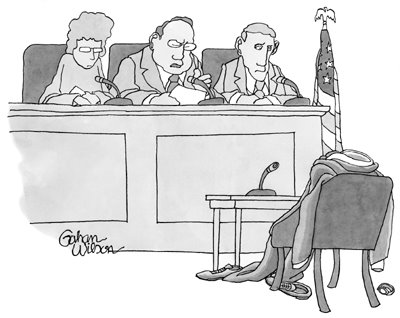
In the back page of The New Yorker, they now offer up cartoons for readers to caption. Not only have I worked with this week's caption contest winner, I've written about him before (during my residency interview, he coined the phrase 'cocktail party research' which I still use frequently... at cocktail parties).
He said his past research was guided so minimal efforts yielded maximum exposure.
With this caption I'd say that he's continued to follow that dictum -- but I've also learned he's written a fiction book about malpractice, surely a lot of effort for a smaller audience than the New Yorker. The book is narrated from the perspective of the defendant, one Dr. Charles (but not that one)...
If the book is as funny as his caption, I'll happily count myself as a member of this smaller audience.
Timeless
By 4:15 AM, the bakers at Hot & Crusty are putting their fresh-baked muffins and croissants on the shelves. If I'm awake and at all hungry, I make a point of stopping by and picking something up.
Which I just did (they're delicious). I thanked the man behind the counter and wished him a good night.
"Good night? It's a brand new day, boss!"
And so it is. I used to be one of those annoying kids in school -- so enamored with the idea of being up past midnight -- that I'd interject every chance I could something like, "technically, it's already tomorrow."
But after these last few rotations through emergency, night and day have lost their special distinctiveness. It doesn't faze me anymore when patients present at wee hours, asking for a "checkup" or inquiring about their monthlong knee pain.
In the city that never sleeps, every moment marks a brand new day, for someone.
Front Row
In one of the emergency departments I work in, the clerk's desk is located near the exit and, shall we say, safely the front-lines of patient care. I sometimes remark to the clerks when they missed a really good case or interesting trauma, but they seem to be happy with their location.
Late one night, I was finishing some charting near the clerk's desk when a family of three came up to say goodbye. Their son had been in a car accident, in which he had lost consciousness. After a negative head CT, a benign exam and some pain medication, he was feeling fine and good to go.
As I wished them a farewell, I remembered an abrasion on the young man's left hand.
"Wait -- I've got just the thing for that," I said, reaching for my bacitracin, gauze and tape (the interns have well-stocked cargo pants).
I put the patient's hand on the clerk's desk and squirted some bacitracin onto the gauze. "Now you're finally getting a front-row seat" I told the clerk.
As I applied the dressing, the patient wobbled a little, and I noticed he seemed a little pale. "Everything ok?"
"uh......."
"Hey, ah, are you alright?"
The patient was staring off beyond my shoulder, with wide, wide pupils. He replied, in a monotone: "I can't see."
He stumbled a little bit and I caught him. "Why don't we get you back to your stretcher," I offered, with a cheeriness that rang utterly false. My mind was racing -- I haven't seen a fainting spell like this, could we have missed an epidural?
At that point, the father slumped to the floor. "My son... My son is blind."
Oh my God, they're dropping like flies.
My attending rushed over to catch him. The man was cold and clammy, similarly pale.
"No, sir, he's ok!" I was insistent. "We scanned his head. He's just... doing what you're doing."
We got the father-and-son team back to the stretchers, had them lie down for a bit, and gave them something to drink. They perked up in short order -- no hematomas, just... relational syncope.
When they felt ready to try again, I walked the family to the door, passing the clerk's desk. She (quietly) warned, "Dr. Genes, I've seen enough tonight."
As we passed through the waiting room, a question occurred to me: "Hey, who's driving?"
The father shot a glance at his son, who was shaking his head slowly. The mom chuckled to herself, as the family made their way out of the hospital.
Respirar Profundo
Songs with the word "breathe" in the title that I have enjoyed, listed in order of when I first heard them:
The newest addition to the list is Anna Nalick's Breathe (2 AM), which played during the climax of Grey's Anatomy tonight. The lyrics should appeal to bloggers, or at least, MySpace users.
Pink Floyd: Breathe in the Air
Prodigy: Breathe
Telepopmusik: Just Breathe
Sixpence None the Richer: Breathe Your Name (hey, cut me some slack, I'm omitting the entries from Maroon 5 and Faith Hill)
Science Dept (featuring Erire): Breathe
Sia: Breathe Me
The newest addition to the list is Anna Nalick's Breathe (2 AM), which played during the climax of Grey's Anatomy tonight. The lyrics should appeal to bloggers, or at least, MySpace users.
Subscribe to:
Posts (Atom)